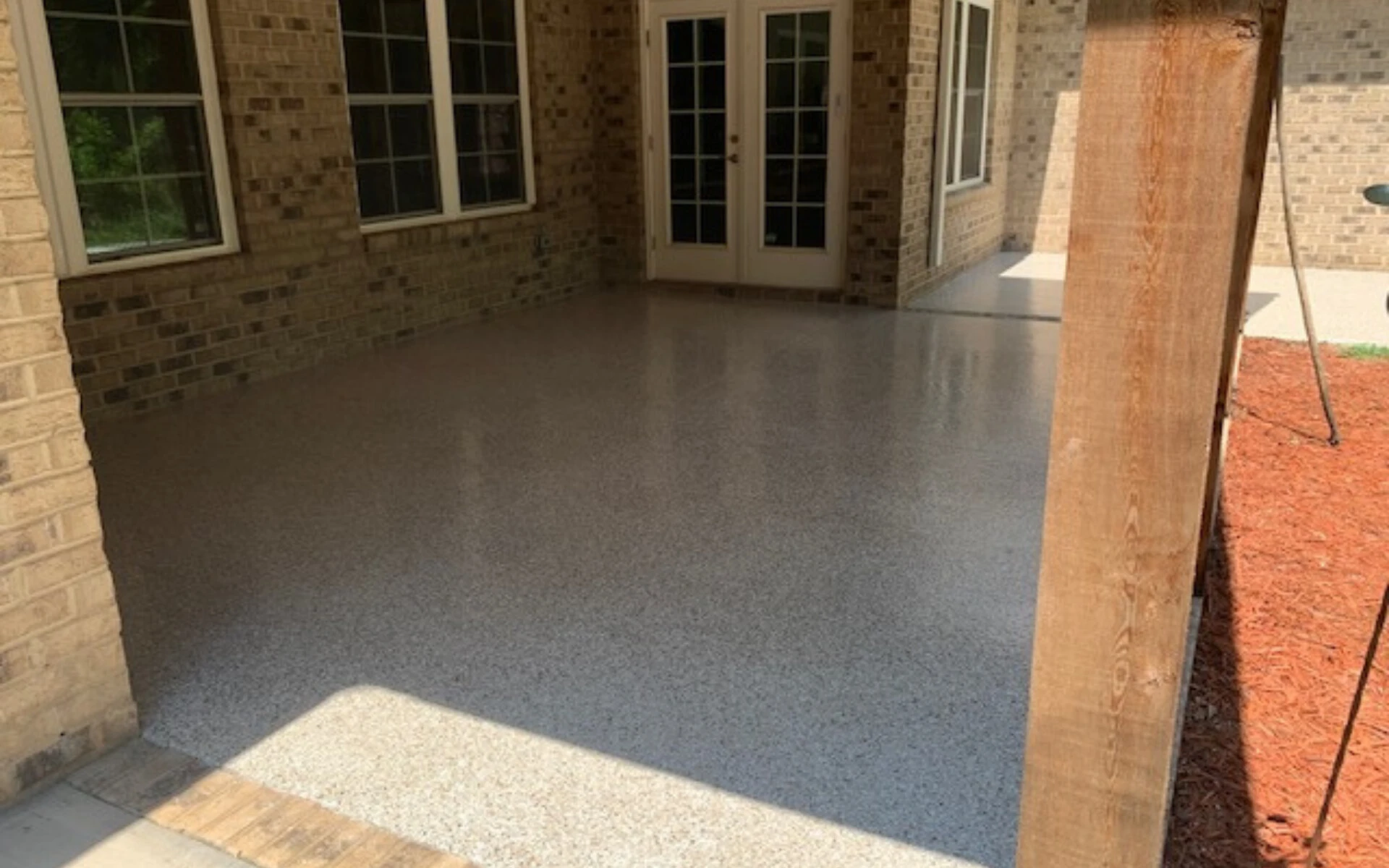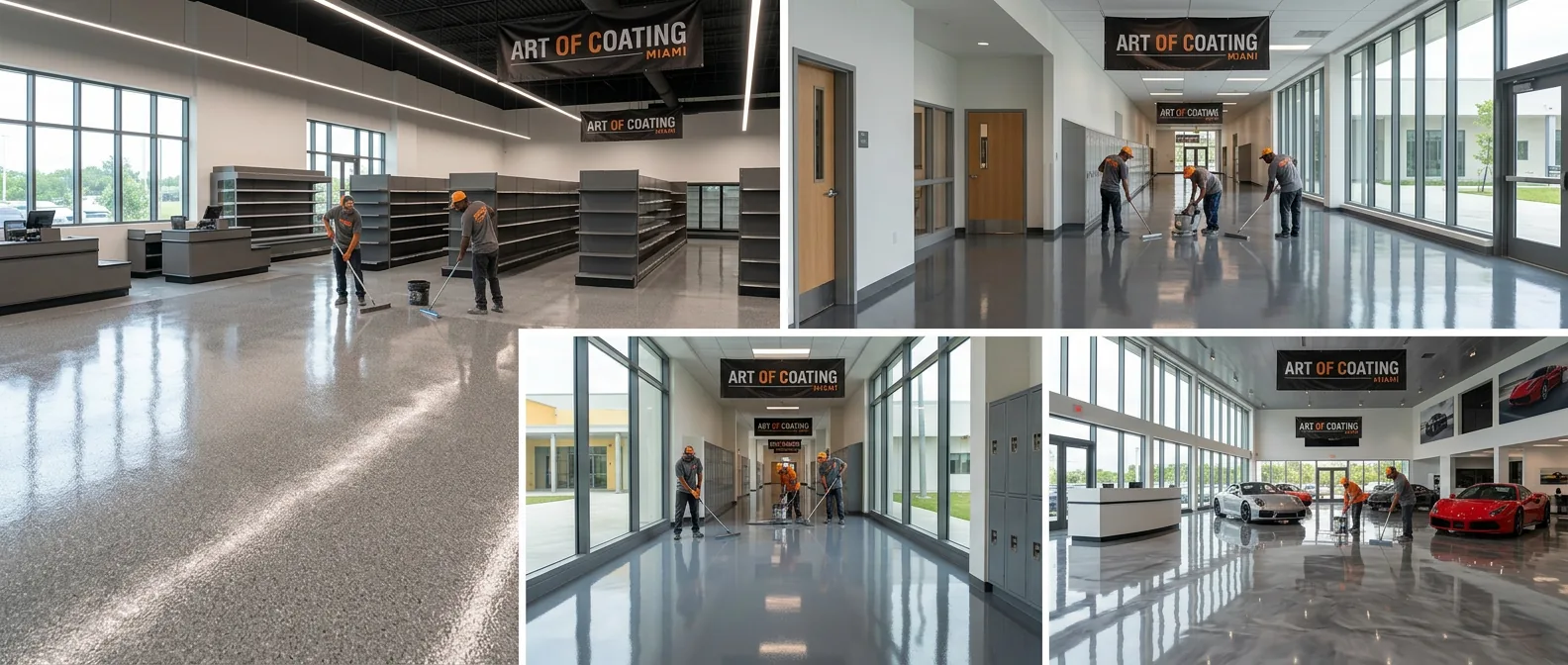

The short answer: for medical, dental and veterinary spaces in Miami, a jointless resinous floor, usually epoxy with a urethane or polyaspartic topcoat, plus an integral cove base and slip-resistant texture in wet areas, is far easier to keep clean than tile, grout or worn VCT. Urethane cement suits sterilization rooms, wash areas and kennels. Commercial systems typically run about $4 to $12 per square foot, and most work can be phased after hours.
Request a Free QuoteIn a clinic, the floor is part of the cleaning plan. Old clinic floors tend to fail in small ways first: stained grout, curling vinyl seams, a glued wall base pulling away, a worn path where carts roll.
This guide, written for practice owners and facility managers in Miami-Dade, Broward and Palm Beach counties, covers what makes a clinic floor easy to keep clean, which systems fit which rooms and how to install without closing the practice. For an overview of the systems we install, see our page on healthcare flooring in Miami.
Why Seams, Grout and Porous Floors Are Hard to Keep Clean
Tile, sheet vinyl and VCT all have joints. Grout is porous unless it is sealed and resealed, and it wears faster than the tile around it. VCT seams open up as tiles loosen and the floor finish wears off, and vinyl seams lift where water gets under them. Each joint holds moisture and soil that a mop pushes in rather than removes, and in Miami's humidity that moisture rarely dries out completely. Bare or poorly sealed concrete is worse: it soaks up fluids, stains easily and sheds dust.
A resinous floor is applied in place as one continuous, seamless film, so there are no joints across the room and cleaning becomes a matter of the surface, not the gaps. The CDC's guidelines for environmental infection control in healthcare facilities treat floors as housekeeping surfaces to be cleaned on a regular schedule and promptly after spills, and they caution against carpet where spills are likely. A jointless, nonporous floor makes that routine faster and more consistent.
Integral Cove Base
The corner where floor meets wall is where most dirt hides. Rubber or vinyl wall base is glued on, and the joint behind it collects debris and fluids once the adhesive lets go. An integral cove base carries the floor coating up the wall in a smooth, curved radius, commonly four or six inches high, finished with a cap strip. There is no corner joint for a mop to miss, and it holds up to wet cleaning far better than glued base. It needs a sound wall behind it, so damaged drywall at the base is repaired first.
Matching the Coating to Your Disinfectants
Clinics clean with chemicals that would dull or soften an ordinary floor finish: quaternary ammonium compounds, bleach solutions, hydrogen peroxide and peracetic acid products, alcohols and phenolics. Many are EPA-registered disinfectants with label contact times that keep the floor wet for minutes at a time, several times a day. Resinous systems are not equally resistant to every chemical, and a topcoat rated for constant exposure to one product may only be rated for occasional splash of another.
Before you choose a system, list the disinfectants and floor cleaners your team actually uses, with their concentrations. Then compare that list against the chemical resistance table in the coating manufacturer's technical data sheet. Your infection-control lead should review that sheet before the system is final. Some manufacturers offer antimicrobial additives; ask for the data sheet.
Slip Resistance and Rolling Loads
Wet areas in a clinic include scrub sinks, sterilization rooms, restrooms, lab sinks, entries on rainy afternoons and, in veterinary practices, the wash tub and kennel runs. Those zones need texture from aggregate broadcast into the topcoat, while dry exam rooms and corridors can stay smoother so carts roll easily and the floor cleans quickly. The US Access Board's guidance describes accessible floor surfaces as stable, firm and slip resistant and limits changes in level, which matters where a new coating meets existing flooring at a doorway. For more on texture choices, see our guide to non-slip floor coatings in Miami.
Clinic floors take more point loads than most offices. Procedure carts, stretchers, wheelchairs and rolling stools concentrate weight on small casters, and dental chairs and some equipment bolt to the slab. A thin coating over a weak or uneven slab will crack or wear through along those paths. A properly profiled slab, a build thickness that matches the traffic and a hard-wearing urethane or polyaspartic topcoat handle this well, and quartz-broadcast systems add wear resistance in the heaviest lanes.
Moisture Under Old VCT and LVT in Older Miami Buildings
Many South Florida practices operate in older office buildings and shopping plazas where the slab may have no effective vapor retarder underneath. VCT and older vinyl let some of that moisture escape through their seams, which hides the problem. Glue-down LVT tends to show it as curling planks, soft adhesive or a musty smell. Once the old floor comes up and a jointless coating goes down, moisture that used to escape has nowhere to go, and it can push the new floor off in blisters.
That is why removal comes before the final system choice. We test the slab using ASTM F1869 calcium chloride or ASTM F2170 relative humidity methods and apply a vapor-mitigating primer when the readings require it. Two cautions: older vinyl tiles and their adhesives can contain asbestos, so have them tested before anyone grinds or strips them, and old adhesive residue has to be ground off completely because a coating will not bond to it.
Which Floor System Fits Each Room
Most practices end up with two or three systems, matched to how each room is used and cleaned.
Exam Rooms, Operatories and Corridors
Epoxy body coats in a solid color or fine flake, finished with an aliphatic urethane or polyaspartic topcoat, are the usual choice for exam rooms, dental operatories, hallways and nurse stations. The epoxy builds thickness and bonds to the slab, while the topcoat adds scratch, stain and chemical resistance and holds its color.
Sterilization, Wet Rooms and Kennels
Sterilization rooms, soiled utility rooms, labs, grooming areas and kennels see hot water, steam, frequent washdown and harsh chemicals. Urethane cement flooring is built for that: it tolerates heat, thermal shock, moisture and constant wet cleaning better than standard epoxy, and it is usually installed with a textured finish and integral cove. It costs more than epoxy, so it is normally limited to the rooms that need it.
Lobbies, Waiting Rooms and Offices
Front-of-house areas see street dirt and rolling chairs but rarely heavy disinfectants or standing water. Polished concrete suits lobbies and waiting rooms on a sound slab, and a decorative epoxy or flake system works where the slab is too patched to polish. Front desks and administrative space can follow the same approach we use for office flooring, so the look carries through the suite.
Installing Without Closing the Practice
Most practices cannot close for a week. A phased plan breaks the job into areas that come out of service one at a time, usually after hours, over weekends or on days the practice is closed. Each phase is isolated with plastic sheeting and, where needed, negative air, and the system chosen for that phase has to reach walk-on hardness before staff return. Fast-curing polyaspartic topcoats help, but timing comes from the manufacturer's data sheet for the temperature and humidity on site, not from a guess.
Odor depends on the product, not the category. Some epoxies and polyaspartics are formulated as low-odor or low-VOC, and others can linger into the next morning in a closed suite. Ask for the data sheet, plan ventilation with your building's HVAC, and give neighboring tenants notice in shared buildings. Diamond grinding runs with dust extraction, but it is loud, so it belongs in an evening or weekend phase.
What Inspectors and Infection-Control Staff Generally Look For
Requirements depend on the type of facility, how it is licensed and what your architect, inspector or code official applies, so treat this as a general picture, not an approval checklist. Design guidance from the Facility Guidelines Institute (FGI), which many states reference for healthcare construction, generally calls for floors that are cleanable, suited to the cleaning methods used and slip resistant where they get wet, with monolithic flooring and integral base in certain clinical rooms. OSHA's bloodborne pathogens standard requires that contaminated work surfaces be cleaned and decontaminated, which is much easier on a nonporous floor. On a walk-through, infection-control staff tend to check for:
- No open joints, cracks, chips or gaps at the edges.
- A sealed, nonporous surface that does not stain or absorb fluids.
- Tight transitions at doorways, drains and around fixed equipment.
- Cove base without gaps where it meets the wall.
- A finish that holds up to the disinfectants actually in use.
We choose systems to help a facility meet the requirements its inspector or code official applies, and we provide the manufacturer's technical and safety data sheets for your records.
Cost and a Planning Checklist
Commercial coating systems typically run about $4 to $12 per square foot, with urethane cement higher. Where a clinic lands depends on removing existing flooring and adhesive, moisture mitigation, crack and slab repair, linear feet of integral cove base, the number of phases and after-hours scheduling, and which rooms need heavier systems. A written, itemized estimate should show each of those separately so you can compare bids line by line. Before you request quotes:
- Map every room by use: dry clinical, wet, sterilization, kennel, lobby and office.
- List the disinfectants and cleaners in use, with concentrations, for the data sheet review.
- Plan for moisture testing after removal and budget for a vapor-mitigating primer if needed.
- Decide where integral cove base is needed and confirm wall conditions.
- Agree on phases, work hours, containment and return-to-service times in writing.
- Confirm what your inspector or code official will apply before the system is final.
Once the floor is in, a simple routine keeps it performing; our commercial floor coating maintenance tips cover the basics.
Frequently Asked Questions
Can a resinous floor go over existing VCT or sheet vinyl?
In clinical areas it is better to remove it. Coatings need a sound, profiled concrete surface to bond, and old tile can loosen, shrink or trap moisture under a new floor. Removal also allows moisture testing before the primer is chosen. Older tile and adhesive should be tested for asbestos first, and if it contains asbestos, removal should be handled by a licensed abatement contractor.
How long will an exam room or operatory be out of service?
It depends on removal, repairs and the system's cure time. With fast-curing topcoats, many rooms can be completed in a phase that fits a weekend or a few evenings. Wet rooms with urethane cement or heavy moisture mitigation can take longer. Your schedule should list each phase and its return-to-service time based on the manufacturer's data sheet.
What does a veterinary clinic floor need that a medical office does not?
More tolerance for water and abuse. Kennel runs and wash areas are hosed down often, urine is constant, and claws scratch soft finishes. That points to urethane cement or a quartz-broadcast system with a textured topcoat, plus an integral cove that keeps water off the walls. Exam rooms and the front office can use the same epoxy and topcoat systems as a medical practice.
Do I need integral cove base in every room?
Not always. It is most valuable in exam, procedure, sterilization, lab, restroom and kennel areas where floors are wet-cleaned often, and some design guidance calls for it in certain clinical rooms. In lobbies and offices, a standard wall base may be acceptable. Your architect, inspector or code official decides what applies to your facility, so settle the cove plan before the estimate is final.
Plan Your Clinic Floor With a Free Site Visit
Every clinic differs in layout, cleaning chemistry, slab condition and how many hours it can give up. Art of Coating Miami is a licensed, insured contractor with a BBB A+ rating, serving Miami-Dade, Broward and Palm Beach counties since 2022. We assess the space, test the slab, propose systems room by room with their data sheets, and give you a written, itemized estimate with a written warranty. Call (786) 618-4877 or schedule a free on-site assessment and we can plan the work in phases around your patient schedule.
Sources & standards referenced
- CDC: Environmental Infection Control Guidelines for Healthcare Facilities
- Facility Guidelines Institute (FGI): Guidelines and Codes for Health Care Facilities
- US EPA: Selected EPA-Registered Disinfectants
- OSHA: Bloodborne Pathogens and Needlestick Prevention
- US Access Board: Guide to the ADA Standards, Chapter 3 Floor and Ground Surfaces
- US EPA: Learn About Asbestos
Product limits always come from the coating manufacturer's technical data sheet for the system installed.
Last updated: November 2026