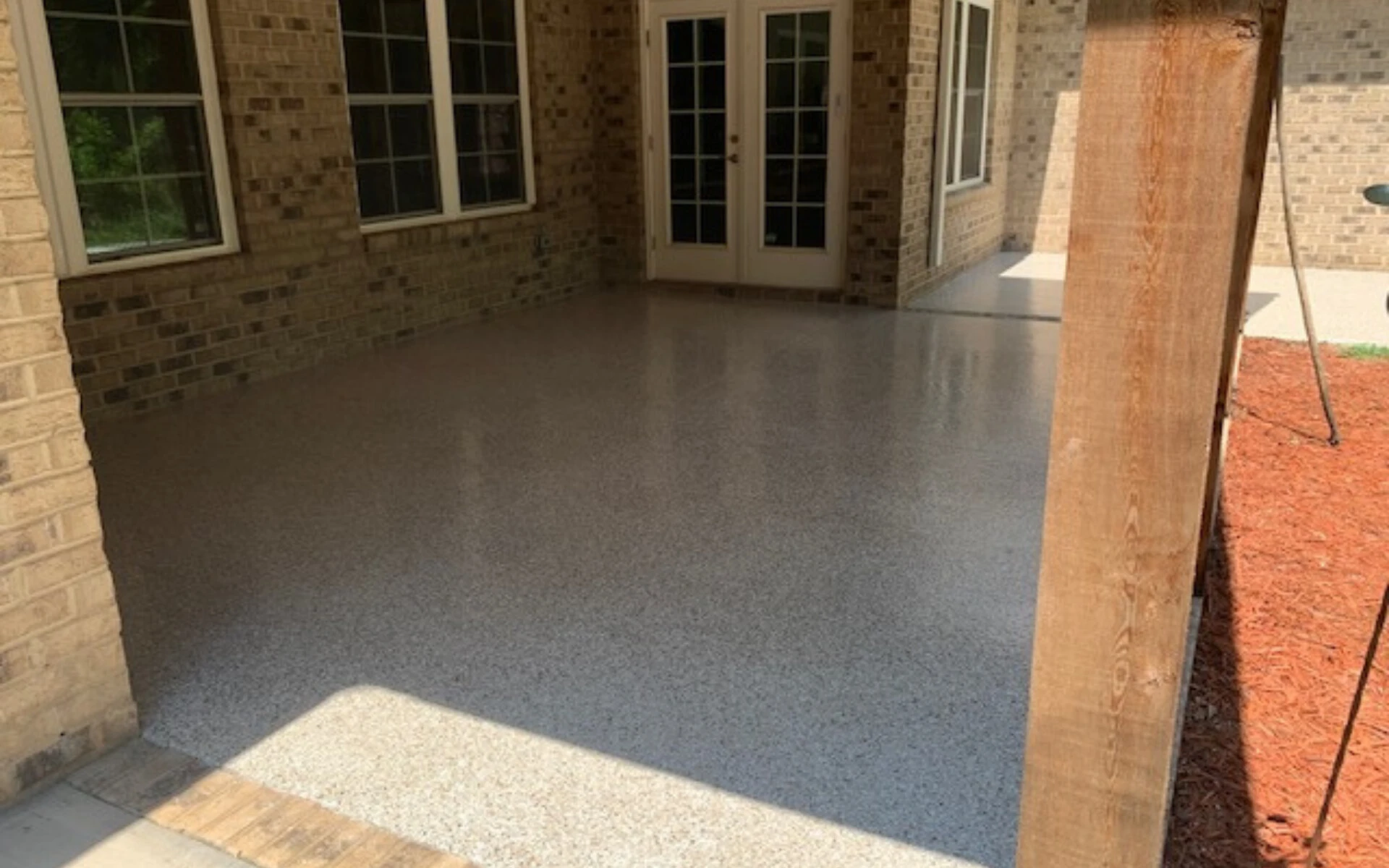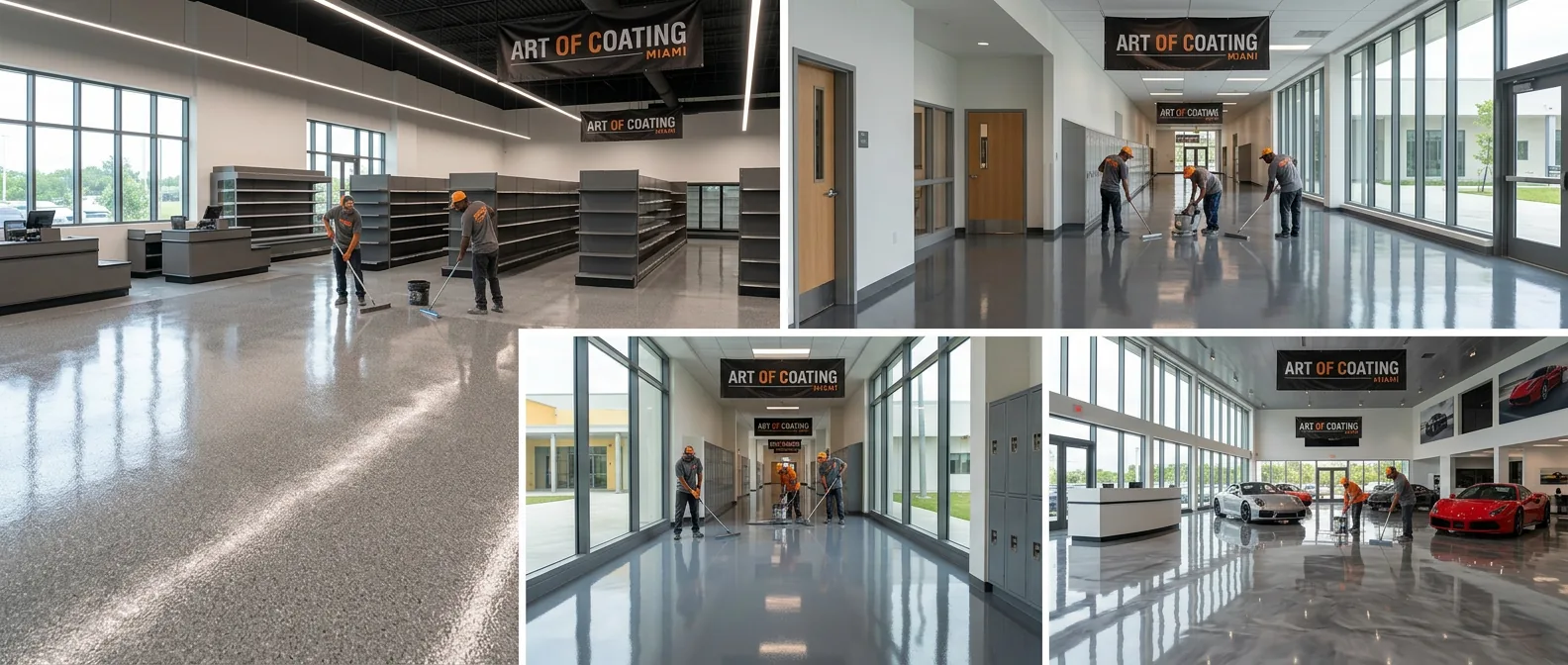

The short answer: urethane cement is the stronger choice wherever a Florida floor sees hot water, steam, thermal shock, fats or organic acids, and on slabs that test damp. Epoxy is the cost-effective choice for dry zones like storage, packaging, corridors and racking aisles, and many facilities use both. Commercial coatings here typically run about $4 to $12 per sq ft, with urethane cement at the higher end.
Request a Free QuoteOwners usually ask this question after a floor has already failed: epoxy peeling at the dish pit, blistering in a processing room, or cracking where hot water hits it every night. Both systems are resin floors, both can be seamless and coved, and both can be textured for grip. Under heat, moisture and chemicals, though, they behave very differently. Here is how they compare in South Florida kitchens, food and beverage plants and warehouses, and how to lay out a floor that uses each one where it belongs.
Chemistry and Thickness: Two Different Materials
Urethane cement is a polyurethane resin combined with cement and graded aggregate, usually mixed on site from three components and placed as a slurry, a self-leveling layer or a heavy trowel-grade mortar. It cures into something closer to a polymer-modified concrete than a paint film. Our urethane cement flooring page covers the system itself; this guide is about choosing between it and epoxy.
Epoxy is a two-part resin and hardener that cures into a hard, rigid film. On its own it is a coating. Built up with broadcast quartz or flake, or mixed with sand into a mortar, it becomes a thicker floor system.
Thickness is where the two separate. A rolled epoxy coating is usually a fraction of a millimeter thick, and a broadcast quartz or flake system typically builds to roughly 1/16 to 1/8 inch. Urethane cement generally goes down at about 1/8 to 3/8 inch, depending on the product and the exposure. That extra mass is a big part of why it handles heat and impact, and also why it costs more to install.
Heat, Thermal Shock and Hot Washdown
Heat is the clearest dividing line. A commercial kitchen floor sees boiling water from kettles, fryer oil splash and nightly hot washdowns. A food plant may steam-clean, run hot caustic wash cycles or roll racks straight from an oven toward a cooler. Each of those events heats or chills the top of the floor faster than the slab below it, and the surface tries to expand or shrink against concrete that is not moving the same way.
Standard epoxy is rigid and does not move like concrete when temperatures swing fast. Under repeated thermal shock it can soften, discolor, crack or let go of the slab, usually starting at the dish pit or in front of the line. Urethane cement is formulated to tolerate those swings, and manufacturers publish heat ratings tied to thickness, with the thicker builds rated for hot water and steam. If a zone sees steam or boiling water, ask for the product's heat rating at the thickness being quoted, not just the system name.
Moisture Tolerance on South Florida Slabs
Much of South Florida sits on porous limestone over a shallow water table, and most ground floors are slabs on grade. Moisture moves up through those slabs as vapor, and a coating that seals the top can trap it. With standard epoxy, that is a common cause of blisters and delamination a few months after installation.
Many urethane cement products tolerate higher slab moisture than standard epoxy and can often go down on younger concrete. That is not a reason to skip testing. We test slabs with ASTM F1869 calcium chloride or ASTM F2170 in-slab relative humidity before choosing a system, then compare the readings to the limits on the manufacturer's data sheet. If a slab tests high and the room is a dry zone, epoxy over a vapor-mitigating primer is often the more economical answer.
Chemical Resistance in Food and Industrial Use
Food facilities attack floors with things that look harmless. Lactic acid from milk and cheese, citric acid from fruit, acetic acid from vinegar and brine, blood, sugars and animal fats all break down weaker floors over time, and the cleaning program adds caustic degreasers and sanitizers on top.
Urethane cement is generally the stronger performer against that mix, especially the organic acids and hot fats. Standard epoxy resists many alkalis, oils and cleaning chemicals well, but organic acids can etch and stain it, and some solvents soften it. Chemical-resistant novolac epoxies close part of that gap and are common in battery charging rooms and containment areas that see stronger acids. For plants with a specific chemical list, our industrial floor coatings are specified against the actual chemicals, concentrations and temperatures, using each manufacturer's resistance chart.
Slip Texture, Cove Base and Return to Service
Slip Texture
Both systems get their grip from texture. Urethane cement can be broadcast with aggregate or troweled with a built-in texture, and its heavier builds hold a coarse profile well in greasy, wet areas. Epoxy uses broadcast quartz or a grit additive in the topcoat. The goal is the same either way: enough grip for wet shoes without a surface so rough it traps grease and shreds mops. OSHA's walking-working surfaces rule expects workroom floors to be kept clean and, where feasible, dry, with drainage maintained where wet processes are used. Our guide to non-slip floor coatings explains how texture levels are chosen.
Cove Base and Drains
Both materials can run up the wall as an integral cove, leaving no square corner where water and debris collect. Urethane cement also needs saw-cut anchor grooves, often called keyways, at every free edge: doorways, floor drains, trench drains, equipment pads and transitions to other floors. Those anchors hold the edges down as the material cures and cycles through heat. Skipping them is one of the most common reasons urethane cement edges lift.
Odor, Cure and Reopening
Cure time depends on the product and the temperature. Many urethane cement installs are back in service within a day or two. Epoxy often takes foot traffic the next day, but forklifts, hot water and chemical cleaning usually wait several days for a fuller cure. Odor varies by product, so ask for the safety data sheet, plan ventilation, and remove or cover food and packaging before work starts.
Cost: What Each System Runs in South Florida
Commercial floor coatings in South Florida typically run about $4 to $12 per square foot. Epoxy systems, including broadcast quartz, generally fall in the lower and middle part of that range. Urethane cement sits at the higher end, and heavily detailed installs can go above it. The main cost drivers:
- Thickness: a 3/8 inch urethane cement build uses far more material and labor than a 1/8 inch build.
- Cove base: priced by the linear foot, and kitchens have a lot of wall.
- Drains and keyways: every drain, trench and doorway needs detailing.
- Prep: removing quarry tile, old coatings or grease-soaked concrete adds time.
- Moisture readings: a vapor-mitigating primer adds a step under epoxy.
- Scheduling: night, weekend and phased work around production costs more.
Compare bids on the same scope: system, thickness, cove height, drain work and moisture plan. A low price per square foot often means one of those items is missing.
Where Each System Fails
Where Epoxy Fails
Epoxy fails when it is asked to do urethane cement's job: under the fryers, at the dish pit, around steam kettles and in washdown rooms that see hot water every shift. It also fails on damp slabs installed without testing or mitigation, and it can amber near open bay doors where sunlight reaches it. In dry rooms on a properly ground slab, it holds up well for years.
Where Urethane Cement Fails
Urethane cement fails when it is installed too thin for the heat it sees, when anchor keyways are skipped, when prep is poor, or when moving joints in the slab are covered over instead of carried through. It also disappoints owners who expect a glossy decorative finish. It is a working floor, colors are limited, and like most resin floors it can yellow or fade where UV light hits it. In a dry office or storage room, it is mostly money that did not need to be spent.
Hybrid Layouts for Kitchens, Food Plants and Warehouses
The most cost-effective floors use each material where it earns its price. The transition between them is a detail, not a weak point: the urethane cement edge is anchored in a saw-cut keyway, and the epoxy is brought up to it.
Restaurant Kitchens
Urethane cement goes under the cook line, at the dish pit, around prep sinks and floor drains, and into walk-in coolers and freezers, thresholds included. Dry storage, offices, corridors and the bar back can take epoxy with broadcast quartz. Our restaurant kitchen flooring guide covers inspections, drains and phasing the work around service.
Food and Beverage Plants
Processing rooms, washdown areas, brewhouses, bottling lines and cold rooms are usually urethane cement territory. Packaging, dry ingredient storage, labs, locker rooms and shipping can be epoxy. Federal sanitation rules for food plants focus on floors that can be cleaned, kept clean and kept in good repair, and they do not name a product. The system is chosen to help the facility meet the requirements its inspector applies, and we provide manufacturer technical and safety data sheets for the file.
Warehouses
Most warehouse floors are dry, and a high-build epoxy, often with a polyaspartic topcoat, covers racking aisles and forklift lanes at a lower cost. Urethane cement or another heavy-duty system makes sense in truck wash bays, cold storage docks and any area where food or chemicals get washed down. Our warehouse and factory flooring page covers the dry-side systems.
Frequently Asked Questions
Is urethane cement better than epoxy for a commercial kitchen?
For the hot, wet parts of a kitchen, generally yes. Urethane cement handles hot washdowns, thermal shock, grease and organic acids better than standard epoxy, and it tolerates more slab moisture. Epoxy with broadcast quartz still works well in dry storage, offices and corridors at a lower cost, which is why many kitchens use both systems on the same slab.
How thick is urethane cement compared to epoxy?
Urethane cement is usually installed at roughly 1/8 to 3/8 inch, depending on the product and how much heat and impact the area sees. A rolled epoxy coating is typically a fraction of a millimeter, and a broadcast quartz or flake epoxy system builds to roughly 1/16 to 1/8 inch. The thicker build is part of why urethane cement costs more.
Can urethane cement go on a slab with high moisture readings?
It can often tolerate higher readings than standard epoxy, but every product has its own limits, so the slab still gets tested first. We use ASTM F1869 or F2170 testing and compare the results to the manufacturer's data sheet. If readings exceed even the urethane cement limit, the moisture source or a mitigation step has to be dealt with before any floor goes down.
Does urethane cement turn yellow?
It can. Like most resin floors, urethane cement colors can yellow or fade with UV exposure, so areas near open dock doors or skylights may shift in color over time. The change is generally cosmetic rather than structural. Indoors under normal lighting, color holds much better, and tan or gray shades hide minor shifts well.
How much does urethane cement cost compared to epoxy in Florida?
Commercial coatings in South Florida typically run about $4 to $12 per square foot. Epoxy systems usually land in the lower to middle part of that range, and urethane cement sits at the higher end or above it, depending on thickness, cove base, drains and prep. A site visit and a written itemized estimate are the only way to price a specific floor.
Get the Right System on Each Part of Your Floor
Art of Coating Miami is a licensed, insured floor coating contractor serving kitchens, food and beverage plants and warehouses across Miami-Dade, Broward and Palm Beach counties since 2022. We start with a free on-site assessment, test the slab for moisture, map the hot, wet and dry zones, and give you a written itemized estimate with the system, thickness and detailing for each one. To set up a visit, contact us or call (786) 618-4877.
Sources & standards referenced
- eCFR: 21 CFR 117.20, Plant and grounds (FDA current good manufacturing practice for food facilities)
- eCFR: 9 CFR 416.2, Establishment grounds and facilities (USDA FSIS sanitation requirements)
- OSHA 1910.22: Walking-working surfaces, general requirements
- ASTM F2170: Determining relative humidity in concrete floor slabs using in situ probes
- ASTM F1869: Measuring moisture vapor emission rate of concrete subfloor using anhydrous calcium chloride
Product limits always come from the coating manufacturer's technical data sheet for the system installed.
Last updated: November 2026