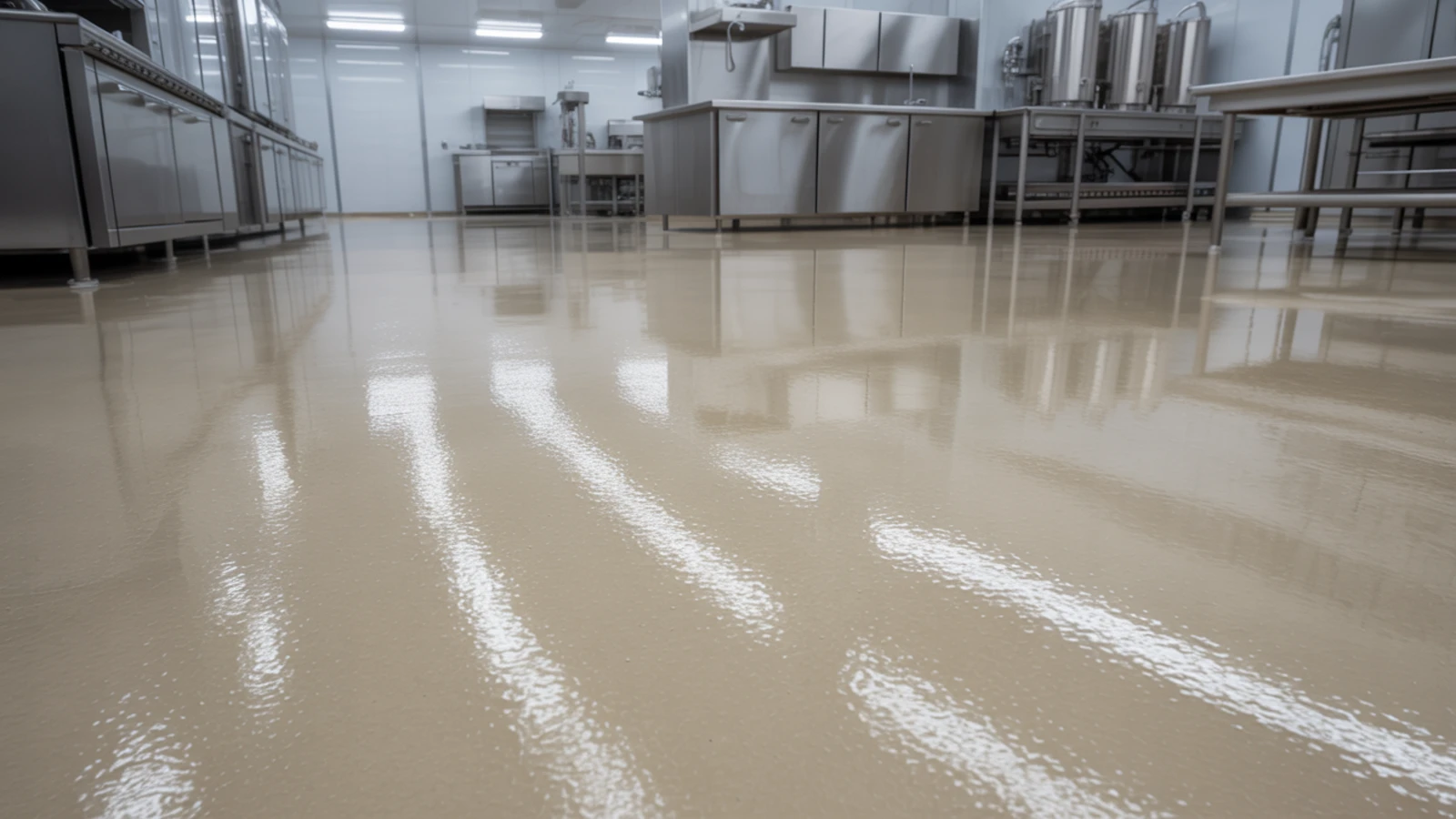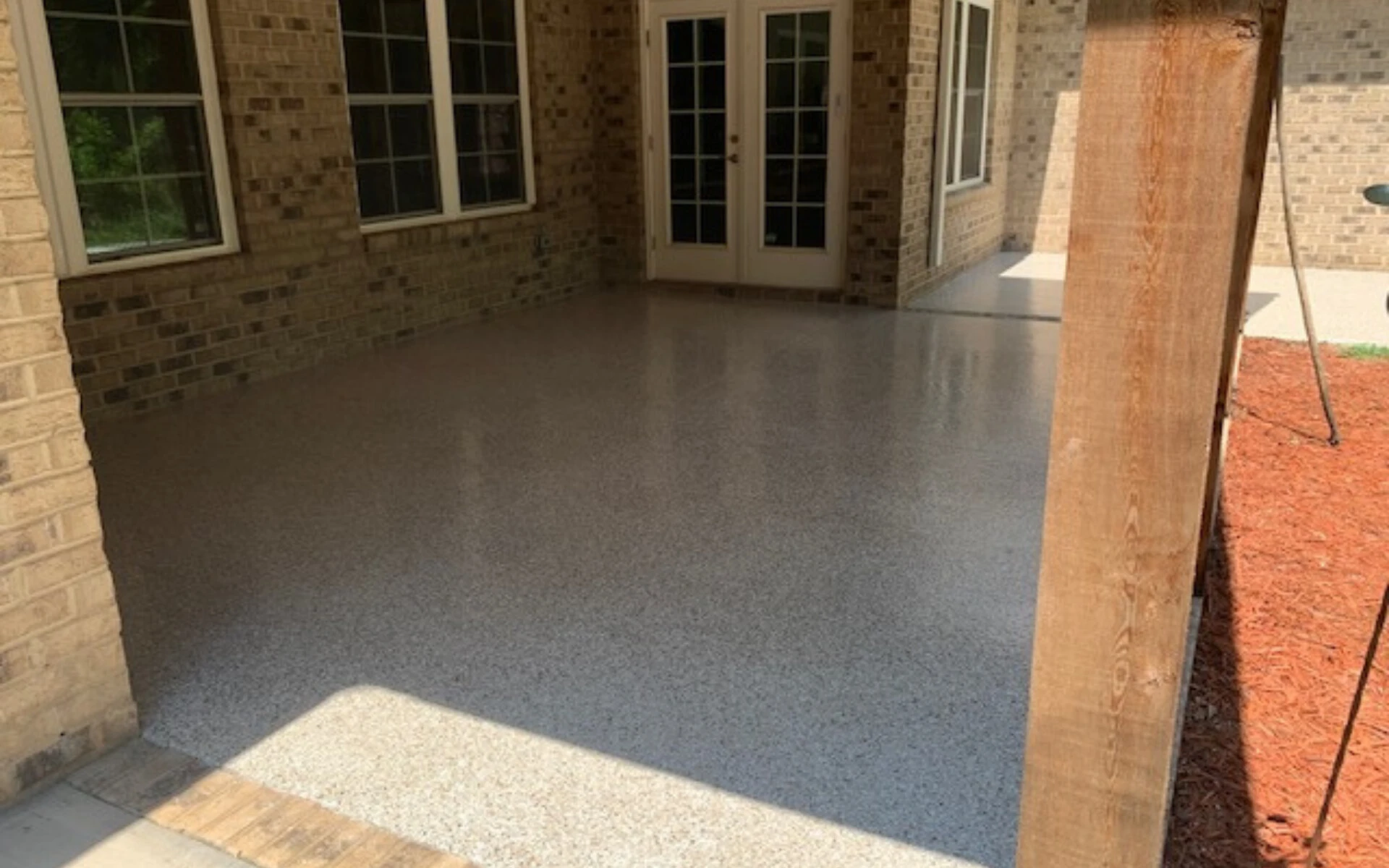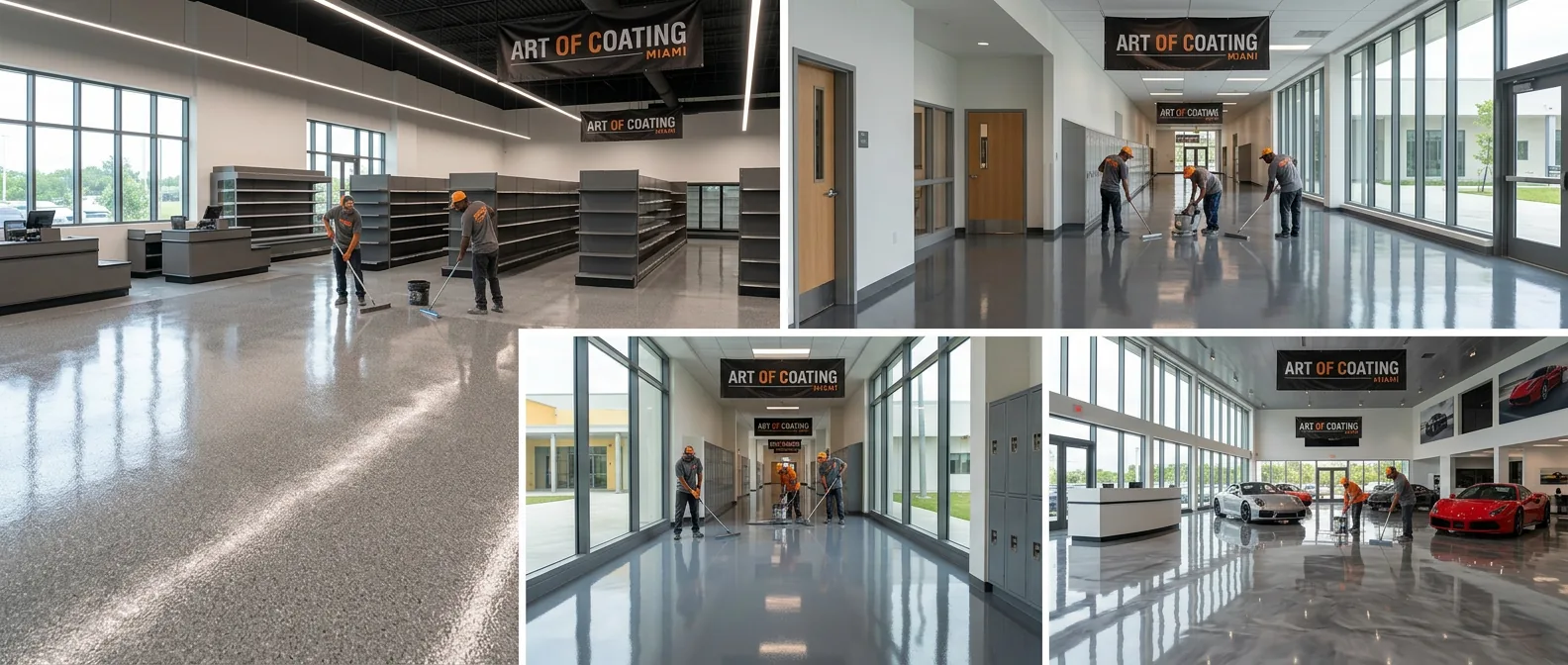
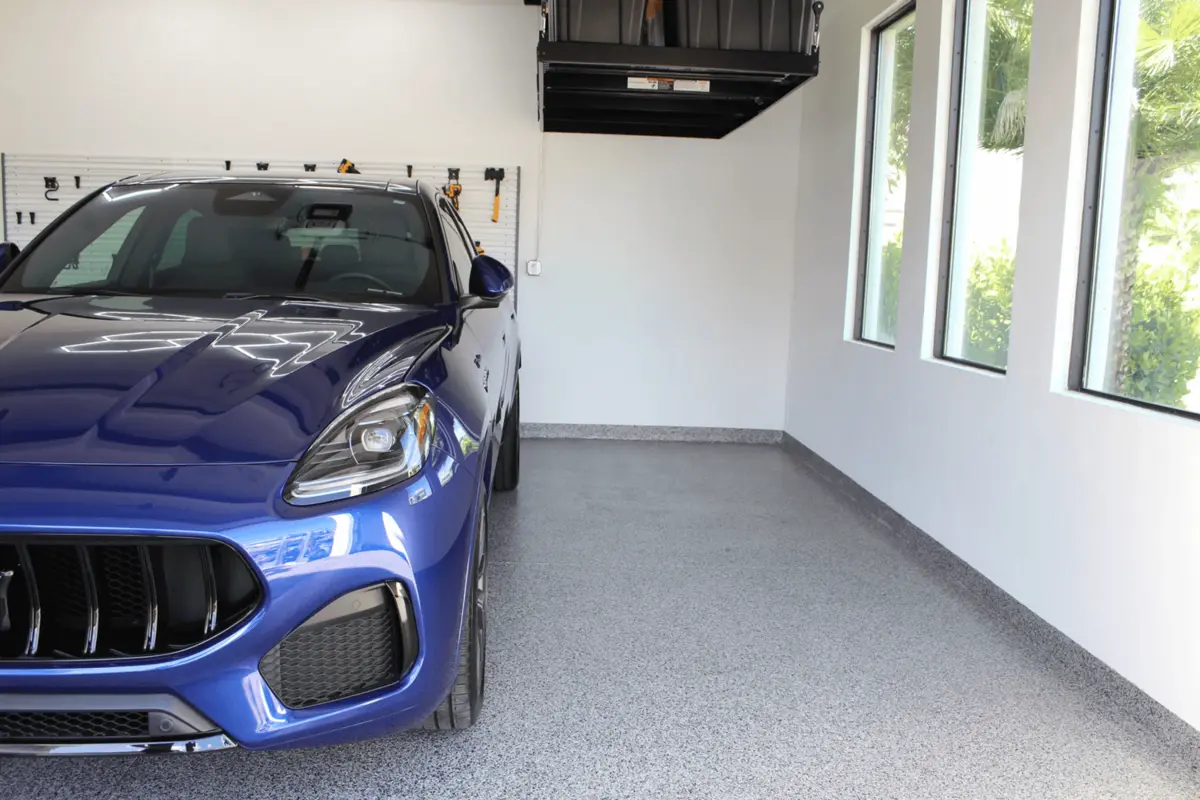
The short answer: in South Florida, moisture coming up through the slab is one of the most common reasons floor coatings blister and peel. ASTM F1869 measures how much moisture vapor leaves the concrete surface over about three days, while ASTM F2170 measures relative humidity inside the slab with probes. Neither has one universal pass mark; the limit comes from the coating manufacturer's data sheet. High readings call for a vapor-mitigating primer or a moisture-tolerant system.
Request a Free QuoteMany of the failed coated floors we are called to look at in Miami-Dade, Broward and Palm Beach did not fail because the coating was bad. Something underneath pushed it off, and that something is usually water vapor. A moisture test takes a few days and a small share of the budget. Skipping it can cost the whole floor. This guide explains why slabs here run wet, how the two standard tests work, what the numbers mean in general terms, and what to ask before you sign a contract.
Why Slab Moisture Causes So Many Coating Failures in South Florida
Concrete is porous. Even a slab poured decades ago keeps moving water vapor from its wetter side to its drier side, and here the wetter side is almost always the ground. A coating that seals the top slows that vapor down. When vapor builds up under the film faster than it can escape, the coating blisters, loses its bond and peels, often months after a perfect-looking install. Our guide to how long epoxy flooring lasts in Florida covers the other common failure causes. Local conditions stack the odds:
- Porous rock and a shallow water table: the USGS describes the Biscayne aquifer under much of the region as highly permeable limestone and sand at shallow depths, with a water table that responds directly and rapidly to rainfall.
- Slabs on grade: most ground floors here sit directly on fill and soil, in constant contact with ground moisture.
- Missing or damaged vapor retarders: ASTM E1745 covers the plastic sheets placed under slabs, but older homes, garages, additions and patios may not have one, and sheets often get torn during the pour.
- Wet season swings: a slab tested in the dry winter months can read differently after weeks of summer rain.
- Humid air: most coating data sheets require the slab surface to be at least 5 degrees F above the dew point during application, which takes planning on muggy days.
That is why we test before an epoxy floor coating in Miami goes down, not after a problem shows up.
ASTM F1869: The Calcium Chloride Test
ASTM F1869 measures the moisture vapor emission rate, or MVER, coming off the surface of bare concrete. The result is expressed in pounds of moisture per 1,000 square feet over 24 hours, usually written as lbs/1000 sq ft/24 hr.
To run it, the tester grinds a small spot to clean, bare concrete, sets a sealed dish of pre-weighed anhydrous calcium chloride on it, and covers it with a plastic dome sealed to the floor. The salt absorbs moisture coming out of the slab for roughly 60 to 72 hours. The dish is then weighed again and the gain is converted into an emission rate. The standard calls for three tests in the first 1,000 square feet and one more for each additional 1,000.
Know its limits. The test mostly reflects the upper part of the slab and the room conditions during the test, and the standard itself notes that results show the slab at the time of testing and may not indicate future conditions. It is not meant for concrete containing lightweight aggregate, or for testing over coatings, sealers or patching compounds.
ASTM F2170: In-Slab Relative Humidity Probes
ASTM F2170 measures relative humidity inside the concrete. The tester drills holes to a set depth: about 40 percent of the slab thickness for a slab on grade that can only dry from the top, or 20 percent for a suspended slab that dries from both sides. A sleeve or probe goes into each hole and is sealed. After it reaches equilibrium, at least 24 hours under the current version, a calibrated meter reads humidity and temperature. Results are reported as a percentage, and the test count matches F1869.
Which Test Tells You More
Because it looks deeper into the slab, F2170 gives a better picture of the moisture that will redistribute once the top is sealed. Many manufacturers now prefer or accept RH testing, and on larger commercial jobs we often run both. The two numbers are not interchangeable, and there is no reliable formula for converting one into the other.
Getting the Space Ready: Acclimation and Test Locations
Both standards expect the space to be at its normal service conditions, with the building closed in and the air conditioning running, for 48 hours before testing and throughout the test. A slab tested with the doors open and no HVAC gives numbers that do not reflect how it will behave in use.
Unconditioned spaces are a judgment call. This comes up most with garage floor coating projects: there is no air conditioning to wait for, so we test the garage as it normally sits and read the results as a guide. Location matters as much as timing. We place tests where moisture is most likely: along exterior walls, near door thresholds, by plumbing and drains, in low spots and in areas that stay damp. A slab that passes in the middle and fails at the edge needs a plan for the edge.
What the Readings Mean
There is no single pass or fail number for concrete. Each coating system has its own limits, printed on the manufacturer's technical data sheet, and that is what the readings are compared against.
As a general guide, many manufacturers of standard epoxy floor systems set limits around 3 lbs/1000 sq ft/24 hr on the calcium chloride test and somewhere in the 75 to 85 percent range on the RH test. Vapor-mitigating primers and moisture-tolerant systems are rated for much higher readings. Use those numbers only to understand a report; the data sheet for the specific product going on your floor is the one that counts.
Two more points. A single high reading in one corner is information about that corner, not the whole floor. And readings taken in the dry season may rise after the summer rains, so a slab sitting right at the limit deserves a more conservative system.
Quick Screens: Plastic Sheet, Moisture Meters and pH
ASTM D4263, the plastic sheet method, is the check most owners have heard of. A square of clear plastic is taped tightly to bare concrete on all edges, left in place, then checked for condensation under the sheet or darkened concrete. It indicates the presence of capillary moisture, which is useful, but it gives no number and can show a false pass when the room is cool or dry. We treat it as a quick screen, never as the test a system decision rests on.
Handheld electronic moisture meters fall in the same category. They are good for mapping a floor to find the wettest areas, and ASTM F2659 covers that kind of preliminary comparison, but they do not replace F1869 or F2170.
A pH check is often done at the same time. Fresh concrete is strongly alkaline, and a surface that was acid etched, a common step with big-box DIY kits, can be left with residue that interferes with bonding. A reading on the wetted surface with pH paper or a meter shows whether the slab sits within the range on the data sheet.
What Happens When the Slab Tests High
A high reading changes the plan, not the project. The usual options, often combined:
- Fix the source first: irrigation hitting the slab edge, downspouts emptying at the foundation, grading that slopes toward the building, plumbing leaks and AC condensate lines all add water a coating cannot fix. EPA's moisture control guidance for buildings treats site drainage and foundations as the starting point.
- Vapor-mitigating primer: a moisture-tolerant epoxy primer applied at the manufacturer's specified thickness over a properly ground slab, with the rest of the system built on top. It adds a step and some cost.
- Moisture-tolerant systems: in commercial kitchens and wet production areas, urethane cement tolerates more slab moisture than standard epoxy.
- Breathable finishes: where a sealed film is not required, a polished or densified concrete floor lets vapor pass instead of trapping it.
One limit applies to all of these. Vapor-mitigating primers are designed for vapor, not liquid water under pressure. A slab that takes on water from below during heavy rain or flooding needs drainage work, and our guide to hurricanes, flooding and epoxy floors covers what a coating can and cannot handle. For commercial wet areas, see our urethane cement flooring page.
What to Ask a Contractor About Moisture Testing
Moisture testing is easy to promise and easy to skip. Before you sign, ask:
- Which test will you run, F1869, F2170 or both, and how many locations for my square footage?
- Will the space be at normal service conditions for 48 hours first?
- Will the tests include exterior walls, thresholds and low spots?
- Which product's data sheet limits will the readings be compared against?
- If readings come back high, what changes, and is a vapor-mitigating primer already priced in or an add-on?
- Will I get the readings in writing with the estimate?
A contractor who answers those clearly is planning around your slab. One who says the floor looks dry is guessing.
Frequently Asked Questions
How long does concrete moisture testing take?
Plan on several days. Both standards call for the space to sit at normal service conditions for 48 hours first. The calcium chloride test then runs about 60 to 72 hours, and RH probes need at least 24 hours to equilibrate after drilling before they are read. We schedule testing early in the assessment so results are in hand before an install date is set.
Do I need a moisture test for a garage floor coating?
Yes. Garage slabs are often the wettest slabs on a property because they sit low, take water at the door and may have been poured without a vapor retarder. A garage coating that blisters in its first year is very often a moisture problem. Testing tells us whether a standard primer is enough or whether the floor needs a vapor-mitigating primer underneath.
Can I do the plastic sheet test myself?
You can, and it is a reasonable first look. Tape a square of clear plastic tightly to bare concrete on all edges, leave it at least overnight, and check for condensation or darkened concrete. A positive result tells you moisture is present. A clean result does not prove the slab is dry enough for a coating, so it should not replace F1869 or F2170 testing.
Is a vapor-mitigating primer the same as waterproofing?
No. A vapor-mitigating primer is designed to reduce moisture vapor moving up through the slab so the coating above it keeps its bond. It is not a waterproofing membrane, and it is not designed to hold back liquid water under pressure from flooding or a rising water table. Drainage and grading problems have to be fixed separately.
What if my slab fails the moisture test?
It usually means a change of system, not the end of the project. Common answers are a vapor-mitigating primer under the coating, a moisture-tolerant system such as urethane cement in commercial wet areas, or fixing an outside water source and retesting. Sometimes a breathable finish like polished concrete is the better fit. Whatever the fix, it should be written into the estimate.
Get Your Slab Tested Before You Coat
Art of Coating Miami is a licensed, insured floor coating contractor serving homes and businesses across Miami-Dade, Broward and Palm Beach counties since 2022. Moisture testing is a standard part of how we plan a floor: we test with ASTM F1869 or F2170, compare the readings to the manufacturer's data sheet, and include any vapor-mitigating primer in a written itemized estimate. Start with a free on-site assessment: contact us or call (786) 618-4877.
Sources & standards referenced
- ASTM F1869: Measuring moisture vapor emission rate of concrete subfloor using anhydrous calcium chloride
- ASTM F2170: Determining relative humidity in concrete floor slabs using in situ probes
- ASTM D4263: Indicating moisture in concrete by the plastic sheet method
- ASTM E1745: Plastic water vapor retarders used in contact with soil or granular fill under concrete slabs
- USGS Ground Water Atlas of the United States: Biscayne aquifer
- EPA: Moisture Control Guidance for Building Design, Construction and Maintenance
Product limits always come from the coating manufacturer's technical data sheet for the system installed.
Last updated: November 2026